
Summary
Editor's rating
Is it worth the money compared to other robot vacuums?
Big dock, low robot: practical but not exactly discreet
Battery life and navigation: enough for a typical UK house
Build quality and reliability: feels sturdy, but the app/firmware is the weak point
Vacuum and mop performance: strong on hard floors, decent on carpets
What you actually get and how it behaves day to day
Pros
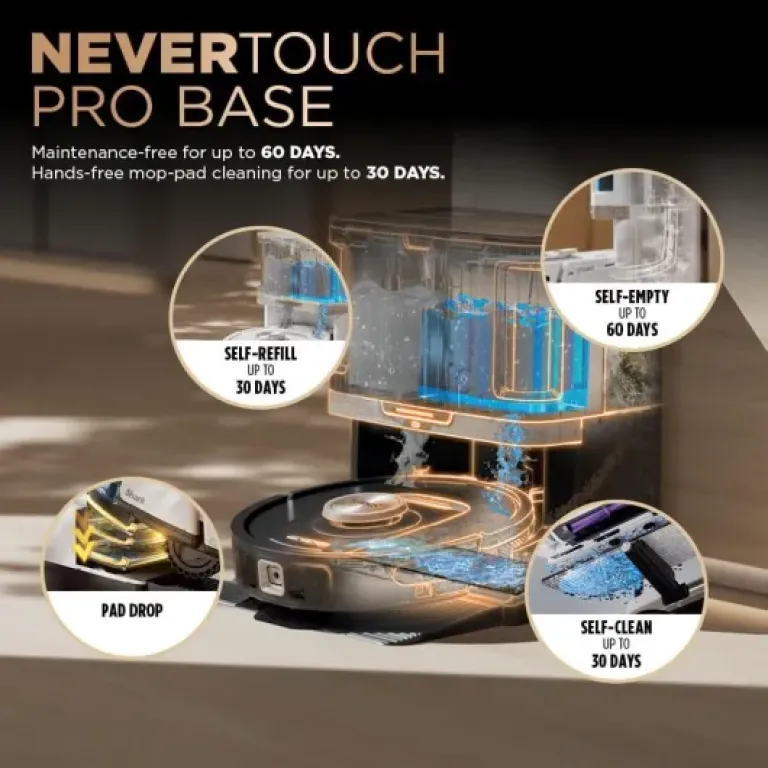
- Very convenient self-emptying and self-cleaning base reduces daily maintenance
- Strong performance on hard floors and decent mopping for everyday dirt
- Good battery life and smart LiDAR navigation cover typical homes without fuss
Cons
- High price, especially considering the software and app can be glitchy
- Carpet cleaning is fine for maintenance but not a full replacement for a manual vacuum
- Large, bulky base takes up noticeable space and isn’t very discreet

Specifications
View full product page →| Brand | Shark |
A robot cleaner that actually saves time… if you can get it running
I’ve been using the Shark PowerDetect robot vacuum and mop with the self-emptying base for a few weeks in a three-bed house with a mix of laminate, tiles and medium-pile carpets, plus a dog that sheds all year. I bought it mainly because I was sick of doing a full sweep and mop every evening, and I wanted something that could just run itself while I was working or putting the kid to bed.
In terms of pure cleaning, it does what it says: it vacuums well, the mopping is better than a quick wipe with a normal mop, and the dock handling the dust and dirty water is genuinely convenient. Once it’s set up and mapped, you can pretty much forget about daily floor cleaning except for emptying the dirty water tank and topping up the clean one every few days. That part is solid.
Where it falls down a bit is on the tech side. The robot itself is fine, the navigation is decent, but the app and onboarding can be a pain. I didn’t hit the extreme bug some people mentioned where the app freezes on the tutorial, but the initial setup was still more fiddly than it should be. Wi‑Fi pairing, firmware update, and mapping took me longer than with cheaper Chinese brands I’ve used before.
Overall, my feeling is: it’s a good bit of kit once it’s up and running, but you need a bit of patience at the start, and you’re paying a premium for the brand and the big dock. If you want something totally hassle-free from minute one, this might annoy you. If you’re okay spending time tweaking the app and maps, the daily convenience is hard to beat in a busy household.
Is it worth the money compared to other robot vacuums?
Let’s be blunt: this thing is not cheap. Around the £800 mark (depending on discounts), you’re in the same territory as some high-end Roborock and Ecovacs models that also offer self-emptying, mopping and smart mapping. So you’re not buying a budget gadget here; you’re paying for a fairly complete robot plus the big maintenance-free base and the Shark name, with a 2-year guarantee if you register.
In terms of what you get for the price, the main value is convenience. The fact that it empties its own bin, washes the mop pad and refills its water tank means you genuinely interact with it a lot less than with cheaper robots. If you’re a busy parent or you work long hours and just want clean floors with minimal fuss, that has real value. I’ve definitely noticed I spend way less time vacuuming and mopping since I set it up, and the house feels generally cleaner day to day.
On the flip side, at this price I expect the software to be rock solid, and it’s not. The app is usable but clunky in places, and the fact that some users can’t even get past the onboarding screen is a big red flag. Also, the vacuum performance, while good, is not miles ahead of some cheaper options. You’re mainly paying for the automation and base, not for twice the suction power. If you don’t care about self-washing pads and 60-day dust bags, you could get a simpler robot plus a decent manual vacuum for less money.
So value-wise, I’d say it’s good if you catch it on discount and you really want the low-maintenance lifestyle. At full price, it feels a bit steep considering the software quirks and the fact that carpets still benefit from a manual deep clean now and then. For tech-comfortable users who don’t mind troubleshooting an app, it’s a fair deal. For someone who hates dealing with apps and Wi‑Fi, I’d honestly look at a simpler or cheaper model.
Big dock, low robot: practical but not exactly discreet
The design is pretty straightforward: a round white robot and a tall white base. The robot itself is fairly low profile, so it can get under the sofa, TV unit and bed frames that my upright vacuum never reaches. That’s a win. The finish is mostly matte plastic with some glossy bits on top around the LiDAR dome and buttons. It doesn’t look cheap, but it’s not some fancy showpiece either – more like a decent appliance you don’t mind seeing in the hallway.
The base is the main visual issue. It’s large, boxy and quite deep because it holds the dust bag plus two water tanks (clean and dirty). If you’re picturing something the size of a normal robot dock, adjust your expectations. It’s closer to a small side table in depth. In my house, I had to commit a corner of the hallway to it and accept that it’s just going to be there, visible. If you care a lot about minimalism, this might annoy you.
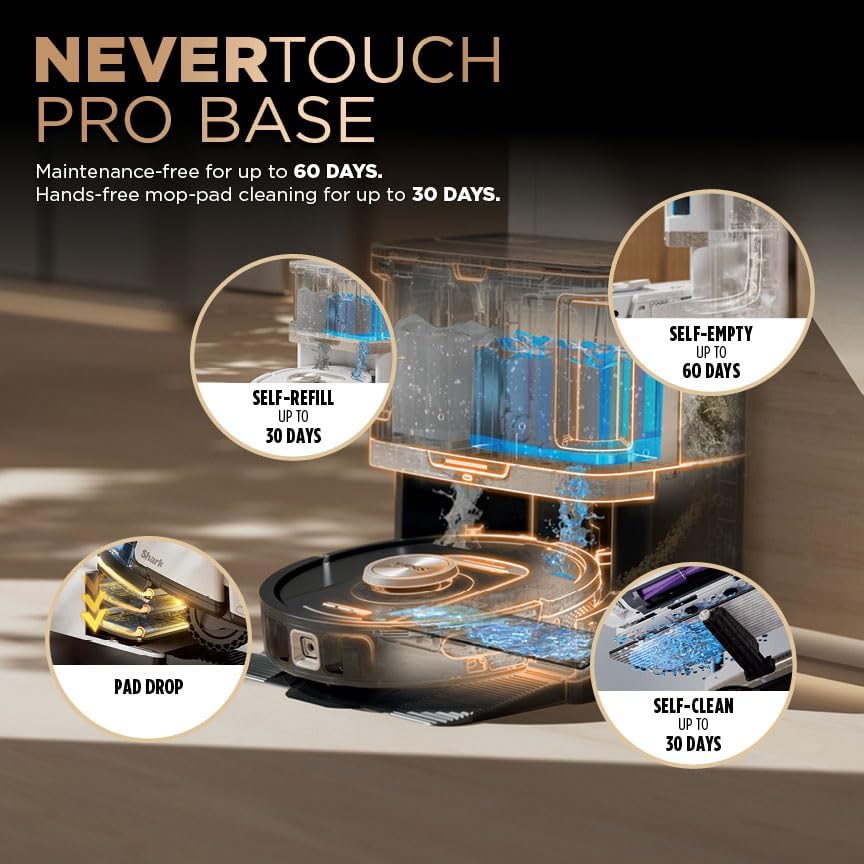
On the positive side, the size of the base is why it can handle the 60-day dust storage and roughly 30 days of water autonomy for light use. The front door to access the dust bag is easy to open, and the water tanks slide in and out without much effort. The labels are clear enough that you’re not mixing up clean and dirty water. The buttons on the robot (start/pause, dock, spot clean) are basic but handy when you don’t want to pull out your phone.
In terms of usability, the 3D LiDAR dome on top does its job. It doesn’t bang into furniture as hard as older bump-only robots I’ve had. It slows down before hitting chair legs and walls most of the time, which means fewer scuffs. That said, it still gets confused by very low black objects (like a thin black metal table leg) and sometimes nudges them. Overall, the design is more about function than style: it’s practical, a bit bulky, and looks like what it is – a robot cleaner plus a mini cleaning station.
Battery life and navigation: enough for a typical UK house
Battery life is one of the things I was pleasantly surprised by. On mixed modes (vacuum + mop, standard power), it cleaned my entire downstairs – hallway, kitchen, dining room and living room, around 55–60 m² – in roughly 70–80 minutes and usually came back with 40–60% battery left. So for most average-sized UK homes, a single run per floor is no problem. If you crank suction to max everywhere, you’ll obviously burn through the battery faster, but I never needed to do that except for quick spot cleans.
The robot is smart enough to recharge and resume if the job is too big. I tried sending it to do the whole downstairs and upstairs (about 110–120 m² total) in one go. It did around 70% of the area, went back to the base to recharge, then later resumed and finished. The handover wasn’t instant – it took a bit before it set off again – but it did work. This is something cheaper robots often fail at, so it’s a plus here.
Navigation with the 3D 360° LiDAR is quite methodical. It doesn’t just bounce around randomly; it does straight lines, room by room, and it remembers the layout once mapped. It handles thresholds and small bumps pretty well thanks to the NeverStuck tech. In my house, it climbs standard door thresholds and a thick doormat without getting stuck. It does sometimes struggle with very light rugs – it can bunch them up or drag them – so I ended up removing one flimsy rug from the hallway.
One thing I noticed: if you move furniture around a lot, the map can get a bit out of sync. It still cleans, but the in-app map looks weird and room boundaries can shift. You can re-map or edit the map, but it’s another thing to tinker with. Overall though, in terms of battery and navigation, it’s reliable enough that I’m comfortable scheduling it to run while I’m out, and I don’t often come back to find it stuck in some dumb place.
Build quality and reliability: feels sturdy, but the app/firmware is the weak point
Physically, the build quality feels decent. The plastics don’t flex or creak much when you pick up the robot, the wheels feel solid, and the hinges on the base for the dust bag and water tanks are not flimsy. After a few weeks of daily use, bumping into chair legs and doorframes, I only see light scuff marks on the bumper, nothing worrying. The mop pads have been through several wash cycles and they haven’t fallen apart or lost much texture yet.
Where I have more doubts is the software reliability. My own unit hasn’t bricked itself, but I did run into a couple of app glitches: once the map disappeared and I had to sync it again, and another time the robot wouldn’t start a job until I fully killed and reopened the app. It’s not catastrophic, but for something this expensive, you expect smoother software. Reading other user reviews, there clearly are some units with serious onboarding issues where the app gets stuck and the robot never does its first run. That’s not acceptable on an £800 product.
On the maintenance side, it’s pretty simple: empty dirty water, refill clean water, change the dust bag every month or two depending on use, and occasionally pull hair out of the brush roller. The anti hair wrap tech helps; hair does collect on the roller, but far less than on my old robot. Filters and pads are washable or replaceable, and Shark usually has spares easily available, which is one advantage of going with a big brand.
Long-term durability is hard to judge after just a few weeks, but based on the feel of the hardware, I’m more worried about app updates or firmware bugs than the motor or plastic cracking. If Shark keeps pushing solid updates and fixes the onboarding problems some people hit, this could be a long-lasting device. If they don’t, you’re basically stuck with an expensive robot that works fine now but might get annoying if future software breaks something. So: hardware feels robust, software is the question mark.
Vacuum and mop performance: strong on hard floors, decent on carpets
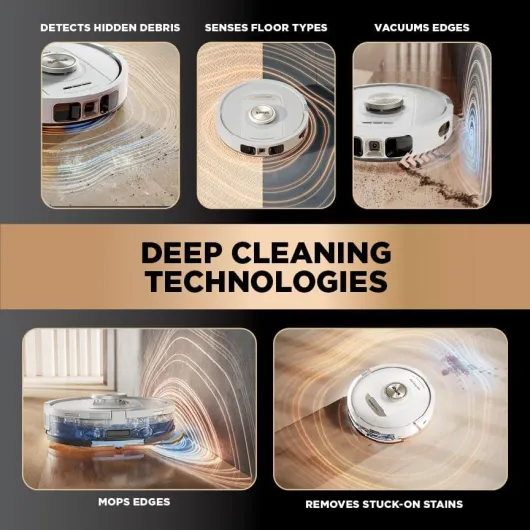
On the cleaning side, it’s pretty solid. On hard floors (laminate, tiles, vinyl), it picks up crumbs, pet hair and dust without issues. I deliberately left the kitchen floor messy for a couple of days – cereal crumbs, dog hair, bits of soil from shoes – and a single pass on standard power cleared almost everything. Only in the corners did I sometimes find a few crumbs left, which is normal for round robots that rely on side brushes to flick dirt inward.
Carpet performance is good but not perfect. On low and medium-pile carpets it pulls up visible debris and a fair bit of dust, but the suction, while strong, is not magic. On my thicker living room rug, I still prefer to go over it once a week with a normal Shark upright on high power. The robot is fine for day-to-day maintenance and catches the surface stuff, but if you expect deep cleaning like a corded vacuum, you’ll be a bit disappointed. Compared to some cheaper robots I’ve had, this Shark is a step up in suction and hair pickup, but it’s not replacing a proper deep clean on difficult carpets.
The mopping is better than I expected. It’s not going to remove baked-on stains from a kitchen floor, but for daily freshening and light spills it works well. The pad vibrates (sonic mopping) and it does a decent job lifting light marks and dried water spots. After the first run, the dirty water tank was pretty grim, which tells me it did more than just drag a wet cloth around. Still, if something sticky dries on the floor, I usually need to pre-spray or quickly scrub that spot myself.
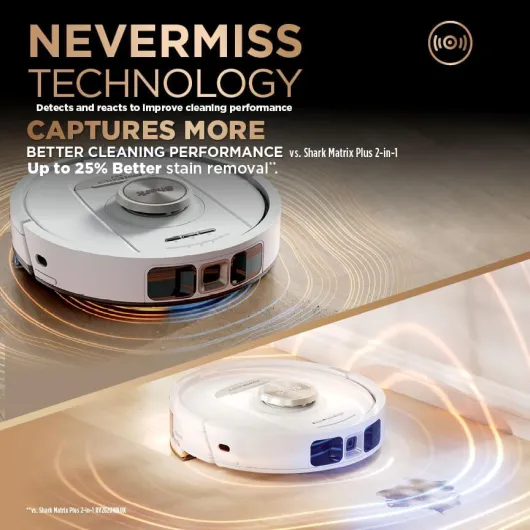
The “PowerDetect” and edge/corner detection features are not just marketing fluff. You can actually hear it ramp up suction when it goes over more heavily soiled areas, like near the kitchen table or by the dog’s bed. It also slows down along skirting boards and tries to follow edges. It’s not perfect – it will miss a bit in very tight corners or around chair legs – but overall, for daily automatic cleaning, it gets the job done well enough that I vacuum manually much less often.
What you actually get and how it behaves day to day
Out of the box you get the robot, the big NeverTouch base, three washable mop pads, two side brushes and an odour cartridge. The base is not small – it’s basically a chunky tower with two water tanks and a dust bag inside – so you need a decent bit of wall space. In my case I had to shuffle furniture in the hallway to give it enough clearance on the sides and in front, otherwise it struggled to dock properly. If you live in a tight flat, the footprint is something to think about.
The first thing it does is a mapping run using the 3D LiDAR. That part was fairly quick for me, around 15–20 minutes per floor. It doesn’t clean during this run, just drives around and builds the map. After that, the app lets you split the map into rooms, rename them and set no-go zones. It’s not super fancy, but it covers the basics: you can send it to just the kitchen, or only mop the hallway, or vacuum and mop the whole floor.
In daily use, the robot is fairly independent. It leaves the base, does its route, then comes back to empty the bin and wash the mop pad. The self-emptying and self-cleaning bits do work as advertised: after a full week of daily runs, the onboard dust bin was still basically empty because it empties to the base each time. The base bag also didn’t fill up anywhere near 60 days in my case (dog hair, crumbs, kid mess), but I can see lighter households getting close to that claim.
Noise-wise, during normal cleaning it’s not too loud – like a low to medium fan noise – but when it empties the dust into the base it gets properly loud for a few seconds. Same for when it washes and spins the mop pad, there’s a noticeable whirring and sloshing. It’s not something you’d want running in the middle of the night in a small flat, but during the day or early evening it’s fine. Overall, as a package, it feels like a fairly high-end robot that’s geared toward people who want to touch their vacuum as little as possible.
Pros
- Very convenient self-emptying and self-cleaning base reduces daily maintenance
- Strong performance on hard floors and decent mopping for everyday dirt
- Good battery life and smart LiDAR navigation cover typical homes without fuss
Cons
- High price, especially considering the software and app can be glitchy
- Carpet cleaning is fine for maintenance but not a full replacement for a manual vacuum
- Large, bulky base takes up noticeable space and isn’t very discreet
Conclusion
Editor's rating
Overall, the Shark PowerDetect robot vacuum and mop is a solid option if your priority is reducing how often you think about floor cleaning. The self-emptying and self-cleaning base actually does what it promises, the hard-floor cleaning is strong, and the mopping is good enough to keep things looking fresh between proper deep cleans. In a busy home with kids or pets, it takes a noticeable chunk of work off your plate.
The downsides are mostly on the tech and price side. The app is functional but not polished, and based on both my experience and other reviews, some units have serious onboarding or firmware issues. At this price point, that’s frustrating. Also, while the vacuuming is good, it doesn’t fully replace a manual high-power vacuum on thicker carpets, so if you were hoping to never touch a vacuum again, that’s not realistic.
If you want a fairly hands-off robot, don’t mind a big dock in your hallway, and you’re comfortable dealing with apps and Wi‑Fi, this Shark is a good fit, especially if you get it at a discounted price. If you’re easily annoyed by software bugs, have mostly thick carpets, or just want something simple and cheap, there are better options for you in lower price ranges or with fewer features.