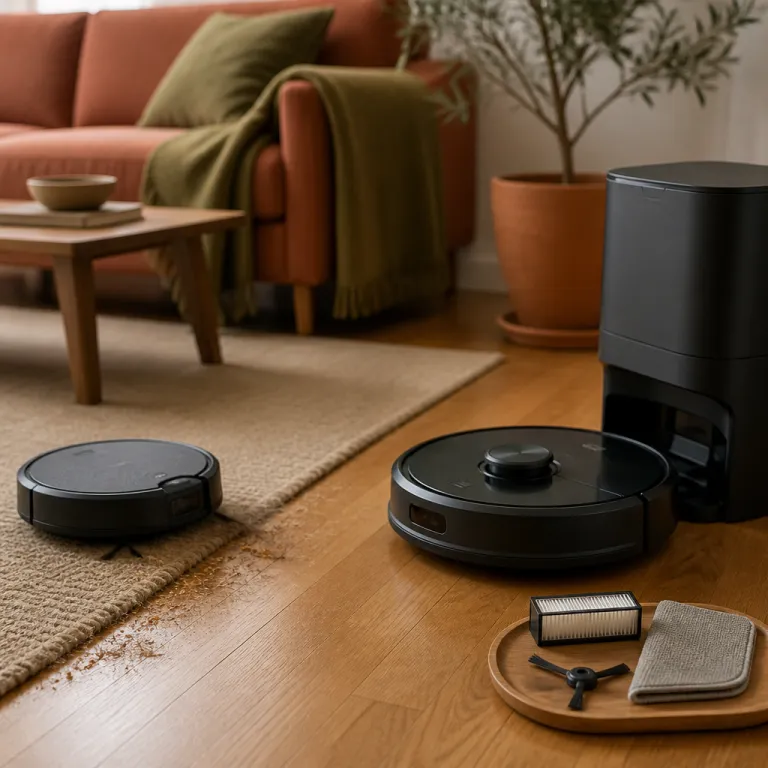
How robot vacuum price comparison changes between $400 and $800
A clear robot vacuum price comparison between 400 and 800 dollars shows that spending more does not double raw cleaning power. You mainly pay for better navigation, stronger obstacle avoidance, smarter docks that auto empty the bin, and more reliable mopping performance that matters in busy homes with kids and pets. For a time strapped parent, the real question is whether those upgrades actually keep floors safer and cleaner with less babysitting of the robot.
At around 400 dollars, models such as the MOVA P10 Pro Ultra, Ecovacs T50 Pro and Eufy E25 Omni already offer solid vacuum performance, decent suction power and basic mop functions. These budget friendly robot vacuums usually combine a single main brush roll with a side brush, standard suction around 4 000 to 5 000 Pa, and a simple vacuum mop pad that drags behind the robot for light mopping. They handle everyday debris on hard floors well, but they struggle more with heavy pet hair in carpets and with sticky spills that need stronger mopping.
Move closer to 800 dollars and the robot vacuum price comparison shifts toward feature rich docks and smarter software. Models like the Dreame L50 Ultra and Ecovacs X9 Pro add auto empty bases, hot water mop washing, and better multi level mapping that remembers several floors in a house. In this band you also see more refined virtual boundaries, more accurate navigation with LiDAR, and obstacle avoidance that can reliably dodge toys, socks and cables instead of pushing them around.
The five upgrades your money buys between $400 and $800
When you compare robot vacuums across this price gap, five upgrades consistently stand out. First is dock quality, because a basic auto empty station at 400 dollars simply sucks dust from the robot vacuum while an 800 dollar all in one dock can wash and dries mop pads with hot water, refill the clean water tank, and sometimes even clean its own tray. Second is navigation accuracy, where higher end robots build faster, more reliable maps and handle complex multi level homes with fewer missed spots.
Third is obstacle avoidance, since premium robots combine cameras and structured light sensors to recognise small objects and reduce tangles with cables, shoes and toys. Fourth is mopping performance, because a cheap vacuum mop usually drags a static pad, while better models use an extending mop arm or dual rotating pads that scrub, lift on carpets, and apply more even pressure on tiles. Fifth is software polish, where the app offers clearer room naming, better voice control integration, more flexible virtual no go zones, and smarter scheduling for parents who need quiet cleaning during naps.
To see this in practice, compare a mid range Ecovacs Deebot with a more advanced Dreame Ultra or Roborock Qrevo in a real family kitchen. The cheaper robot may match basic suction power on crumbs, but the premium robot vacuums usually leave less residue along edges, avoid more obstacles, and return to the dock with a cleaner mop thanks to hot water washing. If you want a detailed look at how a modern dock, LDS navigation and automatic mop detachment work together, a thorough test of an RS20 Max robot vacuum cleaner with a 3 in 1 base station and hot water washing offers a useful benchmark for this kind of robot vacuum price comparison.
For readers comparing self empty stations specifically, a focused review of an Olsen and Smith robot vacuum cleaner with mop and auto empty station shows what you can realistically expect from a 6 500 Pa vacuum mop in the lower half of this price band. That type of robot vacuum combines strong suction power with laser navigation, but it usually lacks hot water mop washing and advanced obstacle avoidance found in more expensive vacuums. In practice, this means more manual rinsing of pads and a bit more babysitting when kids leave scattered toys on the floor.
Which features matter most for pet homes
In homes with dogs or cats, the robot vacuum price comparison tilts heavily toward hair handling and reliability. Pet hair quickly exposes weak brush designs, poor suction power and short battery life, because a robot that stops mid run or clogs its brush roll is not helping a busy parent. Here, spending closer to 800 dollars often buys a sturdier roller, better side brush design, and stronger suction that can pull hair from medium pile carpets.
Look for a robot vacuum with a tangle resistant brush roll, a sealed dust path and at least 5 000 Pa of suction power if you have multiple shedding pets. A well designed roller and side brush combination will funnel debris efficiently into the vacuum intake, while a good auto empty dock keeps the bin clear so suction stays consistent. Some premium robot vacuums also include pet focused modes that increase suction on carpets and adjust cleaning patterns in high traffic zones where fur accumulates.
Mopping performance matters too, because pets track in dried mud and small spills that a simple mop pad cannot lift. Robots like the Dreame Ultra series or Ecovacs Deebot models with an extending mop arm and hot water washing can scrub dried spots more effectively and then dries mop pads in the dock to reduce odours. For a detailed example of how LiDAR navigation, strong suction and app based voice control can work together in a pet heavy home, a test of a robotic vacuum cleaner with 8 000 Pa suction and 180 minute runtime offers a useful real world reference point.
What families with kids should prioritise
For households with toddlers and school age children, the robot vacuum price comparison is less about raw performance and more about safety, predictability and low noise. Toys, crayons and snack crumbs create a minefield where weak obstacle avoidance can lead to jams, while poor navigation can leave sticky patches untouched. In this context, paying more for reliable obstacle avoidance and precise navigation often matters more than chasing the absolute best suction numbers.
Parents should look for robot vacuums that combine LiDAR navigation with camera based obstacle avoidance, because this pairing helps the robot recognise small objects and avoid dragging them across the floor. A good robot vacuum in the 800 dollar range will map rooms quickly, respect virtual no go lines around play areas, and handle multi level layouts without constant remapping. This reduces the need to pre clean the floor before every run, which is exactly what a tired parent does not want to do at the end of the day.
Dock design also affects family life, because a quiet auto empty cycle and efficient mop washing reduce disruption during naps or bedtime. Some higher end docks use better sound insulation and smarter scheduling so the robot can empty and dries mop pads at set times rather than immediately after every run. When you compare robots like the Roborock Qrevo, Ecovacs Deebot X series and Dreame Ultra models, focus on how they behave around clutter, how often they get stuck on an obstacle, and how easy it is to adjust cleaning plans from the app or through voice control.
When $400 is enough and when $800 is worth it
Not every home needs an 800 dollar robot vacuum, and a careful robot vacuum price comparison can save you real money. If you live in a smaller flat with mostly hard floors, limited pet hair and minimal clutter, a 400 dollar robot with solid suction power, basic mopping and a simple auto empty dock can be the best value. In that scenario, you gain most of the cleaning benefit from regular runs rather than from advanced features like hot water mop washing or complex multi level mapping.
On the other hand, large multi level houses, busy pet homes and families with young children often justify the extra spend. The combination of stronger obstacle avoidance, better navigation, longer battery life and more capable mopping performance means fewer missed spots and less manual intervention. Over time, that reliability can matter more than the initial price difference, especially if the robot vacuums run daily and replace several hours of manual cleaning each week.
Think about how often you are willing to empty a bin, rinse a mop pad or rescue a stuck robot from under a sofa. If the honest answer is “almost never”, then the premium dock, smarter navigation and more refined software of an 800 dollar robot vacuum will likely fit your lifestyle better. If you do not mind a little hands on maintenance and your floors are simple, a well chosen 400 dollar robot can still deliver strong cleaning performance without stretching your budget.
Model matchups that clarify the mid range
To make this robot vacuum price comparison concrete, it helps to pair specific models across the price gap. On the lower side, the MOVA P10 Pro Ultra, Ecovacs T50 Pro and Eufy E25 Omni represent what a capable 400 dollar robot can do with decent suction, basic mopping and a functional auto empty dock. On the higher side, the Dreame L50 Ultra, Ecovacs X9 Pro and similar Dreame Ultra or Roborock Qrevo variants show how premium docks, stronger mopping and refined apps change daily cleaning.
In direct use, the cheaper robots usually match the more expensive ones on light dust and small debris, especially on hard floors. Where the gap opens is in how they handle complex layouts, mixed flooring and cluttered rooms with frequent obstacle challenges. Premium robots tend to complete more runs without intervention, maintain stronger edge cleaning thanks to better side brush and roller designs, and keep their mop pads cleaner through automatic washing and drying.
Some readers will also encounter models like the Tapo Max or various Ecovacs Deebot and Roborock Pro series robots when shopping in this band. These vacuums often sit between the clear 400 and 800 dollar anchors, mixing strong suction power with partial premium features such as improved obstacle avoidance or more advanced virtual mapping. When you see marketing terms like “auto empty”, “extending mop” or “pro navigation”, always ask how those features translate into fewer manual chores and better cleaning in your own rooms rather than focusing only on spec sheet numbers.
Key figures that shape mid range robot vacuum choices
- Most mid range robot vacuums now offer suction power between 4 000 and 8 000 Pa, which is enough to lift fine dust and larger debris from hard floors and low to medium pile carpets in typical homes, according to manufacturer specifications across major brands.
- Battery life for robots in the 400 to 800 dollar range commonly falls between 120 and 200 minutes on standard power, which allows a single charge to cover 80 to 150 square metres depending on floor type and layout complexity.
- Independent lab tests from organisations such as Consumer Reports and Which? have found that advanced obstacle avoidance systems can reduce object collisions and tangles by more than 30 percent compared with basic bump and go navigation in cluttered rooms.
- Auto empty docks typically hold the equivalent of 30 to 60 robot dustbins, which means many households only need to empty the dock every 30 to 45 days when running the robot vacuum several times per week.
- All in one docks with hot water mop washing and automatic pad drying can add 150 to 300 dollars to the price of a robot vacuum, but they significantly reduce manual mop maintenance and help maintain consistent mopping performance over time.
FAQ about choosing between $400 and $800 for a robot vacuum
Is a 400 dollar robot vacuum enough for a small flat
For a compact flat with mostly hard floors, limited pet hair and minimal clutter, a 400 dollar robot vacuum can be entirely sufficient. You will usually get solid suction power, basic mopping and sometimes a simple auto empty dock that reduces bin emptying frequency. The main compromises are less advanced obstacle avoidance, fewer multi level mapping options and more manual mop maintenance.
Do I really need advanced obstacle avoidance
If your floors are often scattered with toys, cables or shoes, advanced obstacle avoidance is worth paying for. Camera and sensor based systems in higher end robot vacuums reduce tangles, prevent dragged objects and cut down on rescue missions. In a tidy home with clear floors, basic navigation can be enough and the extra cost may not bring much benefit.
How important is dock quality in daily use
Dock quality has a major impact on how hands off your cleaning routine feels. A basic auto empty dock only handles dust, while premium all in one docks wash and dries mop pads, refill water tanks and sometimes clean their own trays. For busy parents who want to minimise maintenance, a better dock can matter more than a small increase in suction power.
What should pet owners prioritise in this price range
Pet owners should focus on strong suction power, a tangle resistant brush roll and a reliable auto empty dock. These features help manage constant pet hair, dander and tracked in dirt without frequent manual bin emptying or brush cleaning. If budget allows, improved mopping performance and hot water mop washing also help keep hard floors cleaner between deeper manual mops.
Is multi level mapping necessary for a two storey home
Multi level mapping is not strictly necessary, but it makes life easier in a two storey house. Robots with this feature can store separate maps for each floor, remember room names and respect virtual boundaries without remapping every time you move them. If you plan to carry the robot between levels regularly, this capability is one of the more valuable upgrades in the 800 dollar tier.
Sources
- Consumer Reports – comparative testing of robot vacuum cleaning performance and navigation
- Which? – independent reviews of robot vacuums and docking stations
- Wirecutter by The New York Times – long term testing of robot vacuums in real homes